

Why pointing Claude at a shared drive stops working
An agent can read your documents well. The cost is in how many times it has to.
We have spoken with about eighty credit and real estate investment firms about AI. The question I hear most from the people who hold the budget is a fair one: why can’t we just connect Claude to our shared drive?
Someone leading AI at a large lender gave me the best version of it. His firm’s edge, he said, sits on that drive: years of IC memos and deal folders, with every data room download adding 300 to 500 PDFs whose titles may or may not be accurate. He wanted to ask questions across all of it without burning millions of tokens every time.
He is right that the drive is where the value is. Where I’ve landed, after testing this ourselves, is that the agent isn’t the weak point. What’s missing is somewhere for its work to go.
It works better than you’d expect
We built a synthetic deal room, 105 PDFs and 168 questions with known answers, and gave an agent a file listing and a text search. With our first version of those tools, it found the evidence it needed 73% of the time. Then we changed the tools, not the model, and it found it 94.5% of the time. The best search index we tried reached 69.5%. (These measure finding the evidence within a fixed budget of text, not answering correctly.)
That jump is the part I keep coming back to. The model didn’t get smarter between the two runs; what it had to work with did. The room helped too: every file name stated the property, month and document type, which is exactly the organizing a real drive doesn’t have.
So I don’t think the answer to “why not just use Claude?” is that Claude can’t find things. Given the right ground to stand on, it usually can.
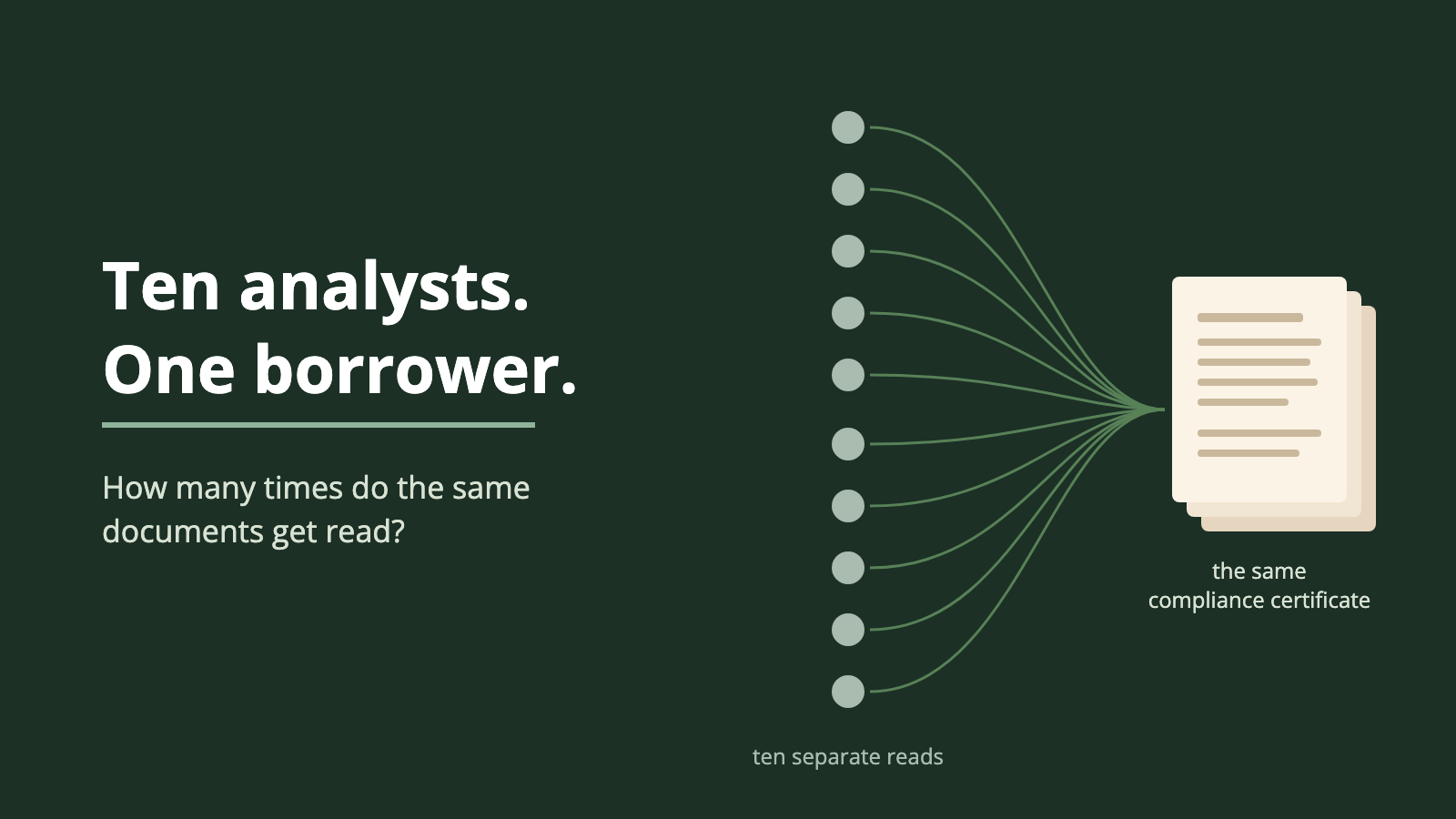
Ten analysts, one borrower
Picture ten analysts at the same fund asking about one borrower in a week. One wants leverage. One wants the revolver balance. One is checking the covenant cushion before a call, and another is writing the quarterly memo.
Their questions are different. The evidence underneath them is mostly the same: the same compliance certificates, the same credit agreement, the same lender presentation.
With an agent on a shared drive, each of those questions starts from the raw files. The agent searches, opens, reads and reasons, and when the session ends that work is gone. Without somewhere to keep it, the next analyst repeats much of that work. Next quarter, all ten do.
I’ve started calling this the re-read tax: what a firm pays each time an agent rediscovers evidence that someone at the firm has already found.
It’s worth being clear about what the fix is not. Caching yesterday’s answer doesn’t help, because today’s question is different. What should be reused is the evidence: the figures, where they came from, and how they relate to each other.
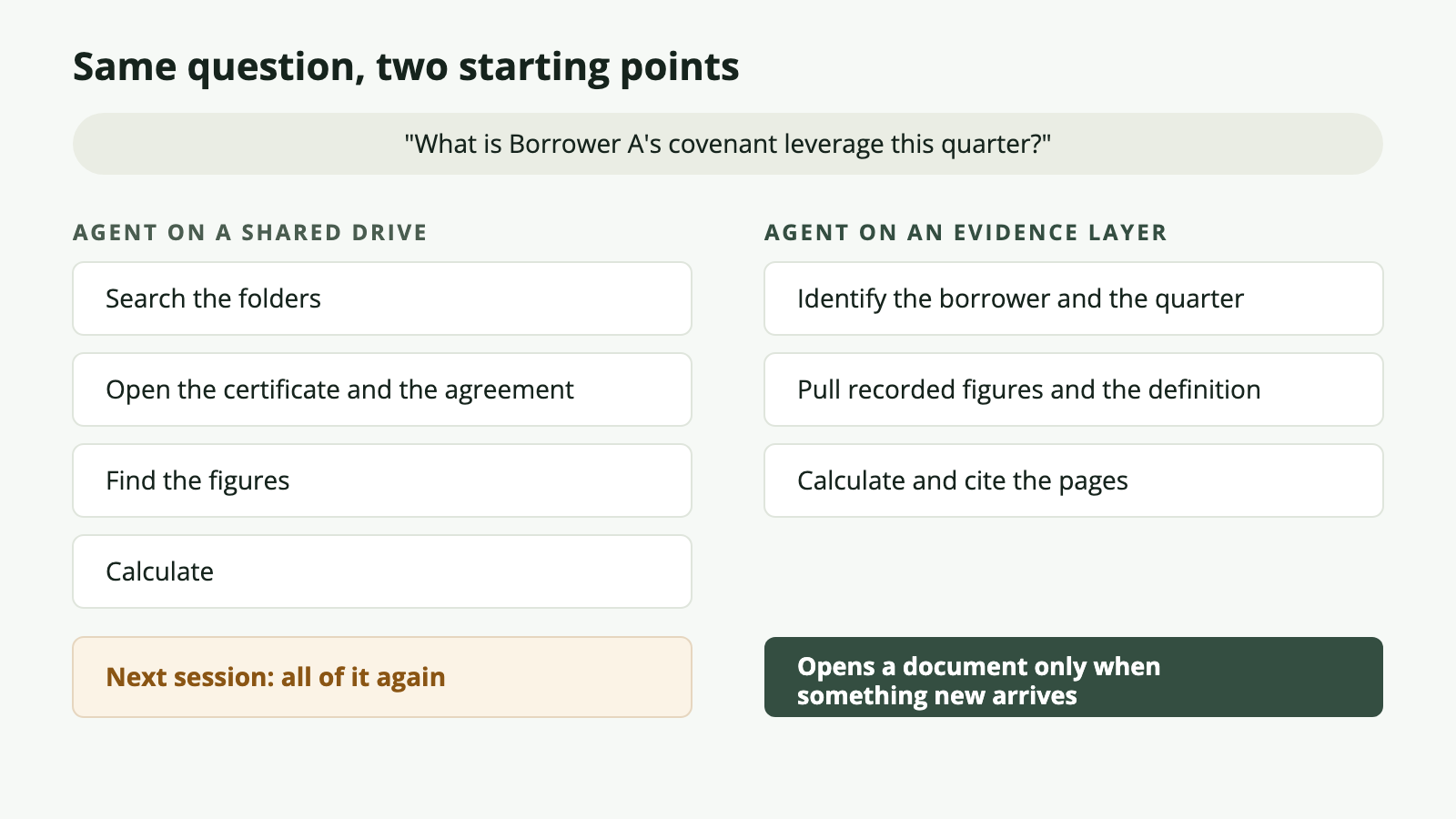
Take “what is Borrower A’s covenant leverage this quarter?” On a shared drive, the agent searches the folders, opens the compliance certificate and the credit agreement, finds the figures and does the calculation, and in the next session it does all of that again. With an evidence layer, it identifies the borrower and the quarter, pulls the figures already recorded with their source pages and the agreement’s definition, and opens a document only when something new has arrived or someone wants to check the page.
What the tax costs
When we measured our own agent, the result surprised me. Across 300 priced turns, the average step (a search, a file read, a calculation) cost about six cents, and that barely changed with how hard the model was asked to think. What made an answer expensive was the number of steps. On 13 test questions, the cheapest answer took about four steps and cost 26 cents. The longest took 22 steps and cost $2.40.
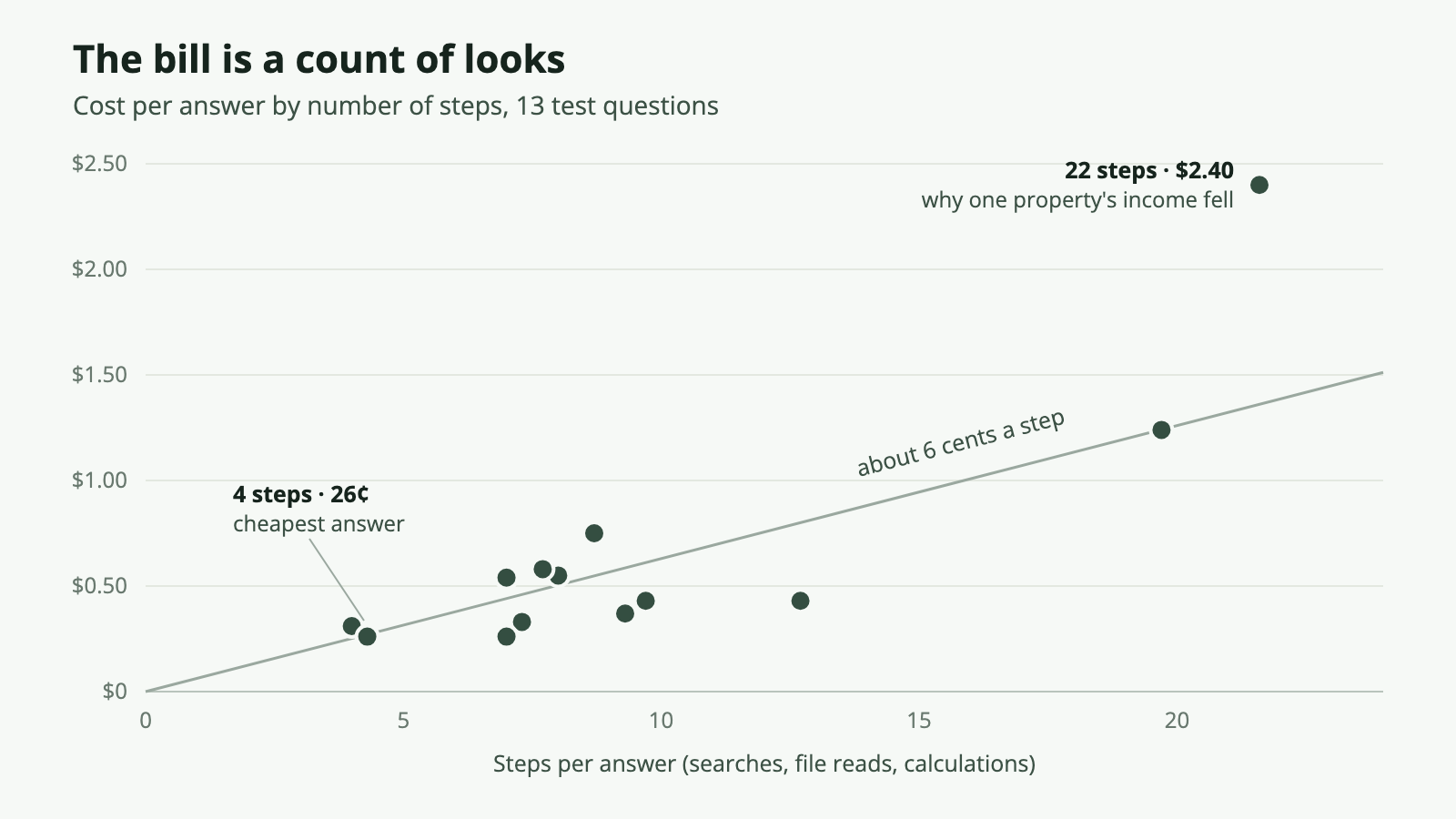
So the bill is mostly a count of how many times the agent looked. Skipping evidence that hasn’t changed lowers the bill, as long as keeping that evidence current costs less than reading it again.
We have one measured piece of this. Putting a filter on document metadata in front of the search, so the agent only looked at the right borrower, period and document type, cut its input tokens by 43% in our test rooms while it found just as much of the evidence. A metadata filter is a small part of an evidence layer, not the whole thing, but the saving is measured rather than projected.
We learned this in our own product first. In an analysis of 90 production questions this summer, the average one consumed about 720,000 input tokens, counted across every model call, so context sent more than once counts each time. About 90% of chat spend came from one feature: a spreadsheet tool, running on a different model from our tests, that loaded entire workbooks again for every question. Its answers were good. It was also paying the re-read tax on every one of them.
Why the drive gets harder, not easier
A small, tidy folder hides the problem. In our test room, part of the agent’s success came from file names that told it exactly what each document was; it called up the file listing in 88% of its attempts. We never tested it with those names removed. A real drive has “Final_v3 (2).pdf”, superseded versions sitting next to current ones, and borrower names spelled three ways.
Our search tool also has limits that matter more as the folder grows. It returns the first matches it finds, unranked, and its file listing stops at 50 documents. On one deal that’s fine. Across a firm’s whole history it’s a risk we haven’t measured yet. We’ve tested agent accuracy up to about 370 documents, and I wouldn’t assume it holds beyond that.
Why relationships, and not just a better index
The obvious engineering answer is to store what the agent reads: a metadata index, a cache, a database of extracted figures. That captures much of the saving, and for some firms it may be enough.
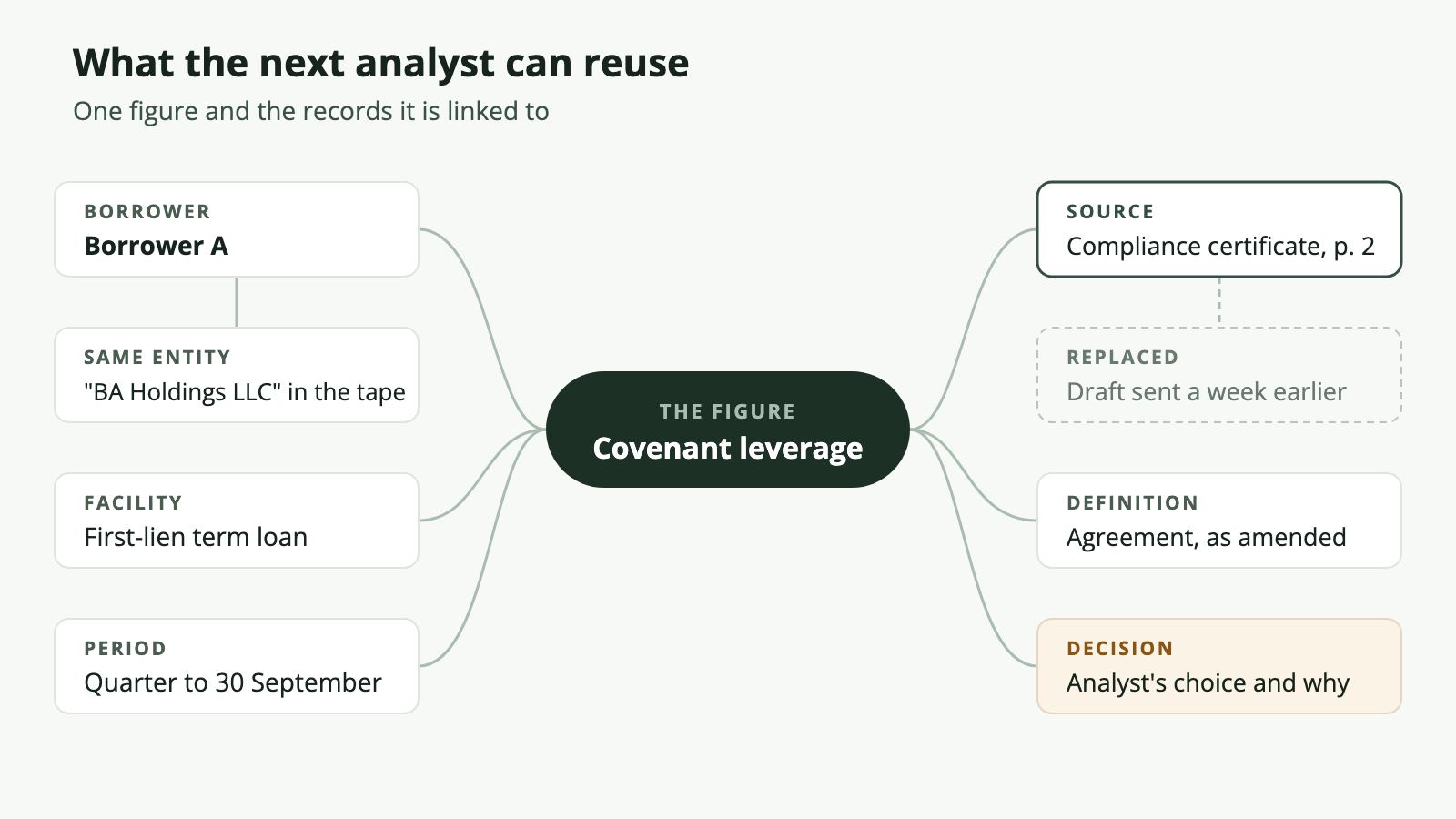
The harder problem is keeping the relationships between those facts. A leverage figure belongs to a borrower, a facility and a period. It came from page 2 of a compliance certificate, which replaced a draft sent a week earlier. The same borrower appears under a different name in the loan tape. An analyst may have chosen one figure over another, for a reason.
Those links are what let the next analyst ask a different question and still reuse what’s known. The database technology matters less than you might expect; relational tables can hold these links too. What matters is that the links are recorded once, kept current and can be followed. A knowledge graph is how we represent them, because it lets an agent go from a borrower to its facilities, reporting periods, figures and source pages without rebuilding those connections every time.
Keeping those links current is where most of the work is, and where we’re spending ours. Knowing that this quarter’s certificate replaced the draft, or that two spellings are one borrower, is easy for the analyst who has covered the name for years. Doing it reliably across thousands of files is not, and it’s the piece we test hardest before it goes anywhere near a credit decision.
The aim isn’t to keep the agent away from the documents. New files still get read, and anyone checking a figure can still open the page it came from. What changes is that evidence that hasn’t changed gets read once, then reused by the next analyst and the next workflow.